Texas McCombs MBA Insider

Insider Information for Prospective Texas McCombs MBA Students

Category: MBA at Houston (page 4 of 8)

Interviewing for a Working Professional MBA Program

After you submit your MBA application, the next step in the application process is your admissions interview.  For the 2022-23 admissions cycle, all applicants for the MBA at Dallas and MBA Houston programs will be interviewed. All interviews will be conducted virtually. 

Working Professional MBA Interviews

For our Working Professional MBA programs–Evening MBA, MBA at Dallas/Fort Worth, and MBA at Houston–interviews will be conducted by a member of the Admissions Committee.

You will receive an interview invitation that will allow you to select an interview time slot that works with your schedule. Be sure to schedule it as early as you can.

Interview invitations typically come within two weeks of your application submission. Be sure to check your email (and your spam folder) regularly after you submit your application, so you can secure your preferred time slot.

An Un-Biased Approach  

Going into each interview, our interviewers have limited access to anything about you or your application, except for your resume. (It’s always a good idea to have a copy of your resume on-hand during the conversation.)

All of our interviewers are fully trained on conducting interviews that are professional, fair, impartial, and helpful. Interviews typically last anywhere from 30 minutes to an hour.

Most interviews follow the general framework of introductions, questions from the interviewer for you to answer, then leave time at the end for you to ask questions about the program and/or application process.

Top Tips

The interview is your official opportunity to share your story, provide examples, and tell us why you chose McCombs like no one else can. Some applicants anticipate an interview and feel nervous, which is natural. If you are nervous, here is some key advice:

  1. Be On Time: Arriving on time is “Interviewing 101,” yet it still manages to trip up even the most prepared of candidates. Please follow all the instructions in your confirmation email about how to connect with your interviewer.
  2. Test Technology: Virtual interviews are being conducted through Zoom. If you don’t have one already, create a Zoom account. You’ll want to find a good space to conduct your interview, ideally with good lighting, stable internet, and access to a power source.
  3. Pace Yourself: You’d be surprised how many times, at the end of an applicant’s long answer, we are asked to repeat the original question. Most often this happens to people who try to put too much into the first answer for fear of not being given an opportunity later on to address their prepared examples.  Don’t worry, you will have time to get to it.  Plus, there is often an opportunity at the end of an interview to mention anything you didn’t address in the formal line of questioning.
  4. Be Professional But Loosen Up: Given our program’s famously friendly culture, our interviews are relatively informal.  If you are nervous, practice your answers in front of a mirror or with a friend and ask them how you did. Did you answer the question? Did you rush through it? Take a moment to outline your answer in your mind first, and then address it calmly and confidently.  Don’t get too comfortable, though. While we’re an easy-going group, maintaining an appropriate level of professionalism is always a good idea. This includes professional language and attire, as if you were interviewing for a job.
  5. Know What We’re Looking For: We listen for confidence, clear and concise communication of career goals, concrete examples of teamwork and leadership, in-depth knowledge of our MBA program, and overall genuine enthusiasm.  Also, the interview can be a place to showcase secondary skills that are difficult for us to determine solely based on your application: interview skills, self-awareness, communication style, and “hire-ability.” Keep these in mind so we can get a feel for your application’s intangibles.
  6. Come with questions: A good list of questions for your interviewer can illustrate a few key things about you as a candidate: You’ve done your research, you care about our program, you have envisioned yourself as an MBA student, and you can formulate coherent thoughts under pressure. We usually leave anywhere from 10-15 minutes for questions, so limit your list to 2-3 good ones and have a few backups.

Take advantage of this opportunity. It can be just the thing the Admissions Committee needs to understand your application’s elements and gives us the chance to get to know you better!


If you have any questions during the application process, we’re here to help. Join us at an upcoming event to connect and learn more about Texas McCombs.  Please sign up for MBA news and follow us on Instagram at @UTexasMBA to stay updated.

Hook ’em!

Working Professional and Executive MBA Essay Questions

Your MBA application essays are an important part of sharing your unique story with the Admissions Committee. The most successful essays will thoughtfully address the prompts, clearly communicate why you want to attend Texas McCombs, and authentically share who you are. 

There are TWO required essays for the Working Professional MBA and only ONE required essay for the Executive MBA. Additionally, you can provide an optional essay if there is something you wish to explain about your candidacy that is not addressed elsewhere in your application. 

Texas McCombs MBA Essay 1 – Working Professional MBA only 

Evening MBA, MBA at Dallas/Fort Worth, MBA at Houston 

We want to get to know you beyond your resume and professional experience. Tell us about yourself. You can discuss your upbringing, core values, formative experiences, special talents/interests, etc. Feel free to be creative and share anything that you think the Admissions Committee will find interesting. Select only one communication method for your response.

  • Write an essay (250 words)
  • Share a video introduction (one minute in length)

First, this prompt is purposely open-ended. It grants you the freedom to introduce yourself in a way that is genuinely “you.” Think about what defines you, what energizes you, or an event that has shaped or influenced who you are today. We want to see what drives you outside of your work and career, and that you are well-rounded and have passions in your personal life. 

Don’t forget about the first sentence of the prompt: “We want to get to know you beyond your resume and professional experience.” The Admissions Committee has already read the rest of your application (resume, transcript, recommendation letter, etc.). We want to better understand you outside of your professional life. 

Finally, the choice is yours: written essay or video. We have seen significant success with both mediums and do not have a preference for one over the other. Therefore, play to your strengths! If your skill is in writing, focus on the essay. Make sure there is clear organization and a flow to your essay. If you’re not shy in front of a camera, then record a video. However, for the video submission, we do not advise submitting a photo slideshow; this doesn’t allow the admissions committee to actually see and hear from you, which is really what we are looking for in a video submission. Have fun with either submission and do not take this essay for granted— it can go a long way in setting the stage for your MBA application and creating another great impression. 

Texas McCombs MBA Essay 2 – Working Professional and Executive MBA 

Essay Two provides an opportunity to explain why you want an MBA and why you’re excited about Texas McCombs.

Take time to reflect on your MBA journey and the direction you want to take in your professional career. Explain how the Texas McCombs MBA program will help you realize your professional goals, and how you will contribute to the McCombs MBA community. (500 words)

In your response, we want to understand why the Texas McCombs MBA is right for you, your aspirations and career plans, and how you want to develop yourself both in and out of the classroom. What resources, organizations, classes, and experiential opportunities specifically relate to your career plan? 

TIP: Connect the dots between your career goals and how McCombs will get you there. 

By answering the second part of the prompt, we will learn what you will bring to the program to make it better than when you arrived.  How do you envision yourself becoming an active member of our MBA community? Do you plan on being an active member or leader of a student organization, or even starting a new club? Let us know! 

Make sure to give us specifics. If you’ve engaged with the program, you know there is a lot to look forward to: challenging classes, organizations, student/alumni networking, award-winning professors, unique career-oriented opportunities…the list goes on. Illustrate what attributes of the program you plan to take full advantage of and how you plan to make a positive impact while you are a student. What will be your MBA legacy? Convince us that you have a unique contribution and are indispensable to our community.   

MBA Optional Statement – Working Professional and Executive MBA 

Please provide any additional information you believe is important or address any areas of concern that you believe will be beneficial to MBA Admissions in considering your application (e.g. gaps in work experience, choice of recommender, academic performance, or extenuating personal circumstances). If living outside of the metro area that the program is held in, please provide an explanation regarding your plans to commute or relocate to the program location. (250 words) 

Optional statements should focus on filling gaps or answering questions we are likely to have about you and your candidacy. Remember that it is just that – optional. Only applicants who feel some piece of their profile deserves more explanation should submit an optional statement. This section of the application is not to tell us more about your extracurricular activities or expand upon your personal or professional introduction. While we love to see how excited you are to share additional information with us, the bottom of your resume or your interview are likely better ways to let the Admissions Committee know about additional projects or information. 

Our Top Essay Writing Tips 

  • Take time to reflect, brainstorm, write, and rewrite. It will likely take more than one draft to realize your final submission.
  • Stay on prompt. Make sure you are completely addressing the essay question prompts. If you bypass the actual questions in an effort to tell us something you think we want to hear, you will not provide the information we are looking for. This includes sticking to the word counts and time limits that are given.
  • Keep in mind the reader. They are reading your entire application including your essays, so do not re-use content from one essay to another or assume the reader knows the professional acronyms or jargon from your job.
  • Don’t copy and paste. Do not use the same content for multiple business schools. We can always spot recycled content.
  • Be honest. These essays are our way to learn more about you. Our community values authenticity and we look for essays that reflect your authentic self.
  • Edit and revise. Have someone you trust read over your essays. Those closest to you can provide valuable insights, feedback, and perspectives as you highlight your personal gifts and qualities.

We hope these insights were helpful and gave you some ideas to think about when writing (and rewriting) your essays. Good luck and happy applying! 


Please email us if you have any questions. Join us at an upcoming event to connect and learn more about Texas McCombs.  Please sign up for MBA news and follow us on Instagram at @UTexasMBA to stay updated.

Hook ’em!

Start Your Weekend MBA Application Today

The application for the Texas McCombs Weekend MBA at Dallas/Fort Worth and MBA at Houston programs is open! Start your application today to be a part of the next century of leaders, innovators, and changemakers.  

Start Your MBA Application Button

APPLICATION COMPONENTS FOR THE 2022-2023 ADMISSIONS CYCLE  

Our Admissions Committee dedicates itself to a diligent, holistic review of each application. Our objective is to determine if you are a good fit for Texas McCombs and ensure that we are the right school for you and your goals. There are no fixed criteria or weighted portions of the application. The following application components will be required this cycle: 

  • Standardized Test (GMAT, GRE, Executive Assessment) or merit-based test waiver  
  • Undergraduate transcripts and graduate transcripts (if applicable)  – must be offical and issued in the last 12 months. International transcripts must include mark sheets, degree certificate, and English translation if applicable.
  • Resume  
  • One Professional Recommendation  
  • Two Written Essays
  • MBA Admissions Interview 

 APPLICATION DEADLINES  

Applications for the Weekend MBA at Dallas/Fort Worth and MBA at Houston programs are accepted in four rounds, and the program enrolls annually every August. Applications should be submitted by 11:59 PM Central Time on the deadline date for each round. Applications are accepted and evaluated on a rolling basis, with a 4 – 6-week turnaround for a decision. 

Round 1 Deadline
Application Due: October 25, 2022
Decision Delivered: December 2, 2022

Round 2 Deadline
Application Due: February 14, 2023
Decision Delivered: March 31, 2023

Round 3 Deadline
Application Due: April 4, 2023
Decision Delivered: May 12, 2023

Round 4 Deadline
Application Due: May 30, 2023
Decision Delivered: July 14, 2023

TESTING REQUIREMENTS AND WAIVERS 

Applicants have several options when considering how to complete the standardized test requirement in their application.  

All applicants are required to submit a GMAT, GRE, or Executive Assessment (EA) score. We will waive the testing requirement if:  

  • Expired (taken 5+ years ago) GMAT, GRE, or EA score report is submitted or 
  • General Test Waiver (merit-based) is approved before application submission 

Standardized exams like the GRE, GMAT, and EA help us to evaluate a candidate’s academic preparedness for the rigor of business school and is also one metric used to compare candidates within a large pool of applicants. However, there are some scenarios where a candidate’s application might shine without the standardized test. 

Learn more about the criteria required to apply for a general test waiver.  

SUBMITTING YOUR ESSAY  

The essay is a critical means of assessing an applicant’s motivation for attending the McCombs School of Business, their background and goals, and their communication and writing skills. Strong applications convey careful research on Texas McCombs and enthusiasm for the program.

The essay prompts for the 2022-2023 admissions cycle are as follows: 

  1. We want to get to know you beyond your resume and professional experience. Tell us about yourself. You can discuss your upbringing, core values, formative experiences, special talents/interests, etc. Feel free to be creative and share anything that you think the Admissions Committee will find interesting. Select only one communication method for your response.
    • Write an essay (250 words)
    • Share a video introduction (one minute in length) 
  2. Take time to reflect on your MBA journey and the direction you want to take your professional career. Explain how the Texas McCombs MBA program will help you realize your professional goals, and how you will contribute to the McCombs MBA community. (500 words)

Additionally, and if applicable, applicants can provide an optional statement in the essay section of the application. Applicants should only provide an optional statement if there is something they wish to explain about their candidacy that is not addressed elsewhere.  

Learn more about submitting your essay.

MBA ADMISSIONS INTERVIEW  

Every MBA candidate will complete an interview with a member of the Admissions Committee. Expect to receive an email with a link to the online schedule after your application fee is reconciled. 

Please note: All MBA Admissions interviews are currently being conducted virtually until further notice. 

Learn more about the MBA Interview.


 The Weekend MBA 2022-2023 Application is open! Please sign up for MBA news and follow us on Instagram at @UTexasMBA to stay updated. 

Join us at an upcoming event to connect and learn more about Texas McCombs. 

Hook ’em! 

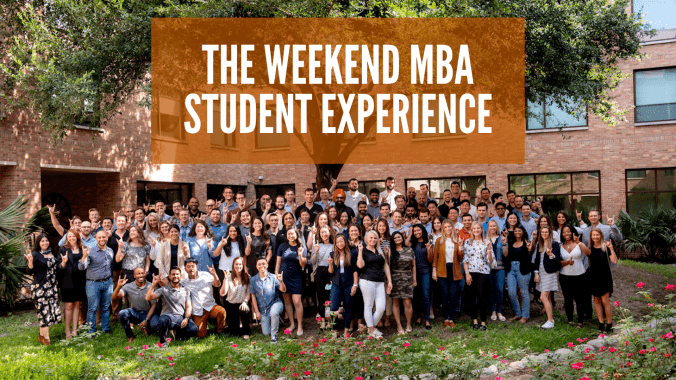
Creating Connections: The Weekend MBA at DFW and Houston Student Experience

The MBA Insider content below comes from Rebecca Gavillet, Managing Director of Working Professional MBA Student Affairs. She writes about the Working Professional student experience and different ways to connect with classmates while in the program. 


The MBA at Dallas/Fort Worth and MBA at Houston programs are offered to those who want a Texas McCombs MBA but do not want to stop working while pursuing their degree. Students take classes every other weekend at the Centrum in Dallas and the Cizik School of Nursing in Houston. The Working Professional MBA programs allow students to immediately apply learnings at work, enhance their careers, as well as transform themselves into leaders. Students can tap into the robust Longhorn network, building lifelong connections with their classmates, other Texas McCombs MBAs, and alumni.

Cohorts and Study Groups

Students are put into cohorts at the beginning of the program and take all classes with their cohort mates. The cohort-based model offers a collaborative learning environment, helping students to network and support one another in their classes. Additionally, each student is assigned a study team of 4-6 students within their cohort. Study teams are created to promote diversity across backgrounds and strengths. Each student will be assigned to four different study teams throughout the program, encouraging student interaction and community building.

“The cohort system allowed us to quickly get comfortable with one another and speak freely in class. As for my study group, I can’t say enough positive things. We all pull the weight and our skills benefit one another so well – like complementary puzzle pieces.”

– Trevor Baugh, MBA at Houston ’23

“I absolutely enjoyed the cohort experience. Looking back, I would not have been able to choose my own classes or plan my MBA path. On top of that, being able to learn through the coursework with the same groups of classmates brought us even closer together. I couldn’t imagine an MBA experience any other way.”

– Jospeh Shih, MBA at Houston ’22

“My study group was one of the most impactful and valuable aspects of McCombs for me. It was just another element of the program that showed me how customized the school made the program. Our study groups were so well-rounded in terms of background that it made learning that much more collaborative and insightful. One person might run point as the subject matter expertise and could help the others by providing real-world examples, etc. It truly helped bring the material to life and make it that much more impactful.”

– Kelsey Charles, MBA at DFW ’22.

Austin Intensives

Austin Intensives are week-long immersions that happen at the beginning of your first and second year on The University of Texas at Austin campus. DFW and Houston MBA students come together for a week of orientation, team building, career management sessions, and McCombs+ workshops, along with academic classes. We still leave time for students to socialize – offering program planned activities, such as dinner and a tour of DKR Football Stadium, and student planned events, such as a Graduate Women in Business (GWiB) hosted social at historic Scholz Garten. While in Austin, students stay in their own room at AT&T Conference Center and Hotel on campus. Most meals are provided, including all breakfasts, lunches, snacks, and some dinners. Meals and accommodations are included in the program cost. The week is definitely intense, but students gain a great amount of learning and networking during the week, along with time to explore campus and Austin.

“I had no clue what Intensives was when I got to Austin. I wondered why we had multiple days of orientation, but I soon realized it was much more than that. I still remember going out the first night with my classmates, building the bicycles in the auditorium, as well as the festivities the last night and the impending headaches while in class Friday before driving home. A truly valuable experience in more ways than one.”

– Trevor Baugh, MBA at Houston ’23

First Semester Residency 

During the fall semester of the first year, students stay at a nearby hotel on class weekends. In Dallas, students stay at the Marriott Uptown and the Hotel Zaza Museum District in Houston – both are a short drive from campus. The residency experience allows students to build community with one another and faculty. It also decreases commute times and allows students to focus on academics. Typically, students go to the hotel immediately following class on Friday and socialize at the hotel bar. There are also ample meeting spaces throughout each hotel for study teams to gather and prep for class the next day. Each student gets their own room during the residency, which is included in the program cost.

“The residency was a great feature of the program. The hotel was the perfect spot to congregate for group work…or meet at the bar for drinks. I wish we had the option to sign up for a room throughout other semesters.”

– Trevor Baugh, MBA at Houston ’23

“Residency is great because it gives you a chance to truly get to know your peers. This program FLIES by. You will be done before you know it and residency is just another way to get to know your fellow classmates and make friends and connections that will last a lifetime.”

– Kelsey Charles, MBA at DFW ’22

Global Trips

One of my favorite components of the program is the Global Studies course, which incorporates a week-long international study tour providing students with a global perspective on business and leadership. Students from the DFW, Houston and Texas Evening MBA students travel together to learn how business is done in another country, as well as experience another culture. This past year, we traveled to Croatia, Germany, Greece, Italy, Panama, Portugal, Spain, and the UAE. In the course, students gain background knowledge of the history, culture, politics, and economics of the region, enhancing their knowledge and understanding of global business.

A student who recently traveled to Italy said the “trip made me a well-rounded and more internationally aware”, while a DFW MBA classmate said, “the best part was interacting with students in the other programs. It was nice getting to know new people that can sympathize with your situation and also exchange stories on classes, projects, etc.”

A Houston MBA student who went to the UAE said he enjoyed, “Spending time with business leaders seeing how strategy, marketing, and operations look in practice, plus visiting the cultural sites including the Burj Al Arab and the spectacular Burj Khalifa; it was completely worth the time and money from a cultural and educational standpoint”.


To learn more about Texas McCombs, visit us online, join us at an upcoming event, and sign up to receive MBA news.

The MBA at Dallas/Fort Worth and MBA at Houston applications are open. The next and final deadline to apply is June 15, 2022.

Working Professional and Executive MBA Essay Questions

The essays in your MBA application are an important part of sharing your unique story. The most successful essays thoughtfully address the prompts, clearly communicate why you want to attend Texas McCombs, and authentically share who you are. We’ve shared some tips below to aid you in submitting a strong set of essays.

Texas McCombs MBA Essay 1

We will learn a lot about your professional background through your resume and letter of recommendation, but we want to get to know you further. Please introduce yourself. Select only one communication method for your response

a. Write an essay (250 words)
b. Share a video introduction (one minute in length)

First, this prompt is purposely open-ended. It grants you the freedom to introduce yourself in a way that is genuinely “you.” Think about what gives you energy and recharges you. When you first meet someone, what’s your personal elevator pitch? How does it share your values? Give us a well-rounded mix of information in this essay so we can better understand you beyond your work life.

Don’t forget about the first sentence of the prompt: “We will learn a lot about your professional background through your resume and letter of recommendation.” The admissions committee already read your resume, letter of recommendation, education history, and goals. While your professional life is important, this essay is your opportunity to share who you are outside of those components.

Finally, the choice is yours: written essay or video. We have seen significant success with both mediums and do not have a preference for one over the other. Therefore, play to your strengths! If your skill is in writing, focus on the essay. If you’re not shy in front of a camera, then record a video. However, if you do submit a video, keep in mind that sending us a photo slideshow isn’t advisable. These slideshow submissions don’t grant the admissions committee the chance to actually see and hear from you, which is really what we are looking for in a video submission. Have fun with either submission and do not take this essay for granted— it can go a long way in setting the stage for your MBA application and creating another great impression.

Texas McCombs MBA Essay 2

Describe how the Texas McCombs MBA will help you realize your professional aspirations, and the unique knowledge and experiences you have to share with your classmates. (500 words)

Essay Two provides an opportunity to explain why you’re applying to Texas McCombs.

By answering the first part of the prompt, we will understand why the Texas McCombs MBA, your career plan, and discover how you want to develop yourself both in and out of the classroom. What classes, organizations, and experiential opportunities specifically relate to your career plan? Connect the dots between your goals and how McCombs will get you there.

By answering the second part of the prompt, we will learn what you will bring to the program.  How do you envision yourself becoming an active member of our community? What personal and professional attributes and experiences will you be sharing with your classmates?

Make sure to give us specifics. If you’ve engaged with the program, you know there is a lot to look forward to: challenging classes, organizations, student/alumni networking, award-winning professors, unique career-oriented opportunities…the list goes on. Illustrate what attributes of the program you plan to take full advantage of and how you plan to make a positive impact while you are a student. What will be your MBA legacy? Convince us that you are indispensable to our community.

MBA Optional Statement

Please provide any additional information you believe is important or address any areas of concern that you believe will be beneficial to MBA Admissions in considering your application (e.g. gaps in work experience, choice of recommender, academic performance, or extenuating personal circumstances). If living outside of the metro area that the program is held in, please provide explanation regarding your plans to commute or relocate to the program location. (250 words)

Honestly, the most important piece of advice we can provide you on the optional statement is to remember that it is just that– optional. Only applicants who feel some piece of their profile deserves more explanation should submit an optional statement. This section of the application is not to tell us more about your extracurricular activities or expand upon your personal introduction. While we love to see how excited you are to share additional information with us, there are other ways to let the admissions committee know about additional projects or passions. The bottom of your resume or your interview are likely better forums for these details. Optional statements should focus on filling gaps or answering questions we are likely to have about you.

Our Top Essay Writing Tips

  • Be patient with yourself. Take time to reflect, brainstorm, rewrite, and EDIT. It will likely take more than one draft to realize your final submission.
  • Don’t Copy and paste. Do not use the same content for multiple business schools. We can always spot recycled content.
  • STAY ON PROMPT. If you bypass the actual questions in an effort to tell us something you think we want to hear, you will not provide the information we are looking for. This includes sticking to the word counts and time limits that are given.
  • Be honest. These essays are our way to learn more about you. Our community values authenticity and we look for essays that reflect your authentic self.
  • Have someone you trust read over your essays. Those closest to you can provide valuable insights, feedback, and perspectives as you highlight your personal gifts and qualities.

We hope these insights into the essay prompts give you some ideas to think about and some points to revisit as you write (and rewrite) your essays. Good luck and happy applying!


Please reach out to the MBA Admissions Team with any questions.

Hook ’em!

Working Professional and Executive MBA Testing Options

Preparing for and taking an MBA admissions exam is one of the best ways to get your mind back into academic mode as you prepare for business school. Some of the most common questions we receive from MBA candidates are about the standardized tests. Texas McCombs MBA admissions is excited to share that working professional and executive MBA candidates have more options than ever before when considering how to complete the standardized test requirement in their application. All applicants are required to submit a GMAT, GRE, or Executive Assessment (EA).  We will waive the testing requirement if:

  • Expired (taken 5+ years ago) GMAT, GRE, or EA score
  • General Test Waiver (merit-based) is approved
  • COVID-19 Test Exception is approved

Standardized exams like the GRE, GMAT, EA, TOEFL, and IELTS help us to evaluate a candidate’s academic preparedness for the rigor of business school and is one metric used to compare candidates within a large pool of applicants.

In addition, studying for and taking the exam – for some, even taking it multiple times – can show the admissions committee your commitment to the competitive business school application process and how you may approach academic challenges as a student.

This post contains a lot of information, broken down into three sections:

  • Test Options for Working Professional and Executive MBA Candidates
  • Which Exam is Right for You?
  • Impact of Your Test Score.

Test Options for Working Professional and Executive MBA Candidates

All applicants are required to submit a GMAT, GRE, or Executive Assessment (EA).  We will waive the testing requirement if:

  • Expired (taken 5+ years ago) GMAT, GRE, or EA score
  • General Test Waiver (merit-based) is approved
  • COVID-19 Test Exception is approved

Our admissions committee does not have a preference on which test you take and there is no minimum score.

Submitting Current GMAT, GRE, or EA Scores

For current scores, you must self-report your test scores in your application as well as have official score reports sent directly to UT Austin by the testing agency. The date that your official scores are sent to UT Austin by the testing agency should be no later than the application round deadline, as it can take up to 3-4 weeks for new scores to be processed. Note that if you are taking the GMAT, GRE, or EA online, you will want to allow up to two weeks to receive your score from the testing agency. You must have your test score in hand by the application deadline in order to submit your application.

Submitting Expired GRE, GMAT, or EA Scores

For expired scores (5 years or older), you must self-report your score and upload proof of the test score in the application. Examples of proof for expired test scores include a score report you received previously from the testing agency OR documentation from another educational institution that previously received the score (e.g. for another graduate/terminal degree application).

About the Executive Assessment (EA)

In 2016 GMAC (who also administers the GMAT exam) saw the need for a new exam, designed specifically for the needs of MBA applicants who have a significant amount of work experience. Originally conceived for Executive MBA programs, the Executive Assessment (EA) exam was launched. Today, almost 100 MBA programs, Full-Time, Professional, and Executive, accept the EA. Unlike the GMAT or GRE, the EA is a readiness exam and a benchmark for academic preparedness. More details about the EA exam can be found below.

General Test Waiver Petition

A merit-based test waiver is available by request prior to submitting your application. Waivers/Exceptions are not available for applicants who have already sent scores to UT.

For candidates who would like to request a merit-based test waiver:

  • Submit the General Test Waiver petition form prior to submitting your application.
  • The General Test Waiver petition form can be accessed directly (UT EID login required) or via the test scores section of the application.
  • Waiver approval is merit-based and takes into account your work experience and academic history. Your resume and transcripts are required for consideration.
  • A decision on your test waiver request will be shared within 5-10 business days after submission.
  • Waivers/Exceptions are not available for applicants who have already sent scores to UT.

COVID-19 Test Exception Petition

A test exception is available if you have been directly affected by COVID-19 and are unable to take the exam in person or at home. Waivers/Exceptions are not available for applicants who have already sent sores to UT.

For candidates who would like to request a COVID-19 Test Exception:

  • Request the COVID-19 test exception form by emailing TexasMBA@mccombs.utexas.edu.
  • Submit the COVID-19 test exception form prior to submitting your application.
  • The COVID-19 test exception is only for those applicants who are unable to take an exam in or at home for reasons directly related to COVID-19.

Which Exam is Right for You? 

The Admissions Committee does not prefer one test over the other in terms of demonstrating your preparedness for business school, but it is important to think about which exam is best for you as an individual. There are different reasons to consider taking the GMAT vs the GRE vs the EA.

​​While the GMAT and GRE tests both have quantitative and verbal sections, they have noticeable differences. We encourage you to do your research and take practice tests to learn each test’s points of emphasis, and how they are scored.

Both The GMAT and GRE are adaptive, which means that your success in answering questions correctly has an impact on the future questions you are given. But the tests deliver adaptive questions in different ways.

  • The GMAT is adaptive by question. When you get an answer correct, the next question is more difficult, and when you get an answer wrong, the next question is less difficult. This also means that once you answer a question, you can’t go back to that question.
  • The GRE is adaptive by section. If you do well on the first verbal section, you get a more difficult version of the next verbal section and vice versa.

We have included some more details about the GMAT, GRE, and EA below, but if you are unsure which exam is best for you, here are our tips:

  • We recommend taking some practice tests! There’s a chance you may be more comfortable with one test format over the other.  At the end of the day, the choice of which exam to take is yours.
  • Build in study time and leave yourself enough room on the calendar to retake an exam if necessary. If you’re not happy with your score, you can retake either test. While many candidates take the test only once thinking it will fulfill the requirement, others recognize that a second effort is likely to yield improvement. It comes at the cost of additional time and another test fee, but the payoff can be significant if it makes you a stronger candidate.
  • Make sure you submit your application as confidently as possible and with a score you feel good about.

GMAT 

For many years, the GMAT was the only standardized test accepted by business schools, but in the last decade, that has changed. Like Texas McCombs, many schools accept the GMAT, GRE, and EA with no preference for one test over another. However, it’s important to be aware that the GMAT is still used by most large consulting and investment banking companies as a baseline qualifier for the recruiting process. If consulting or I-banking are in your sights, this means that the GMAT is the best choice. The Fine Print: Not ALL consulting and investment banking firms look at your GMAT – boutique consulting firms, for example, typically do not ask for your score. So this is not a one-size-fits-all rule but is something to consider if those industries are of interest to you.

Exam Structure:  The GMAT has only one section each of verbal and quantitative questions. Within each section, a handful of questions are experimental, however, you won’t know which questions count towards your score and which are experimental. The verbal section of the GMAT focuses on grammar (sentence correction) and reading comprehension. In the quantitative section, the GMAT questions center on problem-solving and data sufficiency– you will get some questions where you have to understand if you have enough data to reach a conclusive answer. The GMAT also includes an Integrated Reasoning section, which measures how well you use data to solve complex problems, and an Analytical Writing Assessment, which asks you to analyze an argument and communicate your critique of that argument through a written essay.

Scoring: The GMAT overall scoring range is 200-800, with verbal and quant sections scored on a scale of 6 to 51. The verbal and quant sections both count toward your overall score. The Integrated Reasoning and Analytical Writing sections are scored individually.

Preparation: The amount of time you need to study for the GMAT will be unique to your individual circumstances. However, on average, candidates report that they spend 3 – 6 months preparing for the GMAT exam.  You can find more information and resources for GMAT preparation at MBA.com.

Time to Complete:  3.5 hours total (including two optional breaks) with 30 minutes for Analytical Writing, 30 minutes for Integrated Reasoning (12 questions), 62 minutes each for the quantitative section (31 questions), and 65 minutes for the verbal section (36 questions). The GMAT is considered the ultimate test of executive decision-making. Time is short and you only have one section of each format, so you must what questions are worth spending the most time on.

Cost: $250 – $275 USD depending on location

Delivery: The GMAT is delivered in-person at testing centers or online. You can take the GMAT once every 16 days, no more than five times in a rolling 12-month period, and no more than eight times total. Within the overall limit, you can only take the GMAT online exam up to two times.

Learn more about the GMAT at mba.com/exams.

GRE 

Sometimes the GRE is the best choice for applicants who have already completed a Master’s degree or those who are pursuing their MBA in conjunction with other Master’s degrees, for example, our dual degree programs. Taking only the GRE allows you to apply to both programs separately with one score, a convenience factor that most dual-degree applicants very much appreciated.

Exam Structure: The GRE has two sections of verbal and two sections of quantitative questions, plus one additional section that could be either verbal or quantitative. This additional section is experimental– your responses won’t count toward your score – but like the GMAT, you don’t know which section is the experimental one. So you have to treat each section on its own as if it will count toward your score. The GRE is also known for having a tough vocabulary portion (antonyms, analogies, and sentence completion) in the verbal sections, along with reading comprehension. Quant questions focus more on geometry and data comparisons. Also, the GRE quant includes questions where more than one answer is correct, and you must select all of the correct answers to get credit for that question. The GRE does give you the use of an on-screen calculator, though this provides only basic arithmetic functions. The GRE also includes an Analytical Writing section, which includes an “Analyze a Task” question and one “Analyze an Argument” question.

Scoring: The GRE gives you one score for verbal and one score for quant, both ranging from 130 to 170. There is no total score for the GRE.

Preparation: Preparation time will vary based on your individual schedule and strengths. ETS offers a variety of free and low-cost tools to help you prepare for the GRE exam.

Time to Complete: The overall testing time for the GRE is about 3 hours and 45 minutes, consisting of 60 minutes for Analytical Writing, 60 minutes for two sections of Verbal Reasoning questions (20 questions per section), 70. minutes for two sections of Quantitative Reasoning (20 questions per section), along with some un-scored and research questions.

Cost: $205 USD

Delivery: The GRE can be taken at testing centers or online. You can take the GRE once every 21 days, up to five times within any continuous 12-month/365 day period.

Learn more about the GRE at ets.org/gre.

Executive Assessment (EA) 

The Executive Assessment is a readiness exam and a benchmark for academic preparedness. It is designed specifically for busy, experienced professionals. Anyone is eligible to take the EA.

Exam Structure: There are three sections on the exam – quant, verbal, and integrated reasoning with the type of questions for quant and verbal on the EA being very similar to GMAT. The integrated reasoning section has four types of questions: multi-source reasoning, graphics interpretation, two-part analysis, and table analysis.

Scoring: The total score ranges from 100 to 200 with all three sections weighted equally (0-20).

Preparation: The EA was designed to require minimal preparation, but we recommend putting in enough prep to feel comfortable when you take the exam. On average, candidates put in 21-30 hours of prep time before taking the EA. This test is good option for busy working professionals looking for a way to demonstrate their MBA readiness without the rigorous preparation that the GMAT and GRE demands.

Exam Length: The test is shorter in duration compared to the GMAT and GRE. The test takes about 90 minutes to complete for 40 questions – 30 minutes for Integrated Reasoning (12 questions), 30 minutes for Verbal (14 questions), and 30 minutes for Quant (14 questions).

Cost: $350 USD

Delivery: The Executive Assessment is available both online and in-person at test centers worldwide making the assessment available around the clock to ensure you meet your application deadlines. You can take the Executive Assessment up to two times.

Learn more about the EA at gmac.com/executive-assessment.

Impact of Your Test Score

Future Employment

Before you make a final decision on your testing options, it’s best to research some of your target companies or industries and determine two things:

  • The extent to which they evaluate a test score in reviewing job candidates.
  • Whether they have a preference for one of the tests. At McCombs, we have found that most consulting and investment banking firms do look at the candidate’s test scores, and both industries historically have favored the GMAT.

Regardless of which test you take, you should consider it as another opportunity to not only impress the Admissions Committee, but also potential employers.

Academic History

Does your undergraduate or graduate transcript accurately reflect your academic ability? If your GPA is low, and you do not submit a strong test score, the admissions committee may have concerns about your ability to succeed in the rigorous MBA curriculum.

One other factor to consider is whether or not your quantitative ability shines elsewhere in your application. While many of our MBA students come to McCombs from non-quantitative majors, these applicants are typically able to prove their quantitative prowess through their test scores. If you come from a non-quantitative background and do not submit a strong test score, you will need to find other areas within your background or experience that can demonstrate your quantitative skills. At the end of the day, we want to make sure that you are set up to succeed academically in the program. If the admissions committee has concerns about your quantitative ability, it may impact your chance of admission, or you may be required to complete pre-MBA coursework prior to admission and/or prior to enrollment.

Scholarships

Scholarship awards are competitive and limited in number. Scholarship decisions are based on a longstanding holistic review process that takes into account your entire application and serves to assess the overall strength of your candidacy, including readiness for academic rigor, career goals, leadership potential, and fit with our program culture. Submitting an application without a strong test score may limit the information available to award a merit-based scholarship.


Please reach out to the MBA Admissions Team with any questions.

Good luck and Hook ’em!

Who Should Write Your MBA Recommendation?

The Texas McCombs MBA application requires one professional letter of recommendation from a person who has supervised your work and/or has assessed your performance during your career.

A recommendation letter is one of the only things you rely on someone else to provide in your application. Circumstances differ for every applicant and deciding who you should ask will vary.  Below are some scenarios to help guide you in choosing the best recommender for your application.

Your Supervisor

Your current direct supervisor is traditionally the best choice. This is likely the person in your network that knows your strengths and weaknesses better than anyone else. However, this may not be a viable option for you.  Perhaps you aren’t able to communicate to your employer that you’re applying to business school or you do not work with your direct boss that closely. It could also be that you attained a new role recently and your current supervisor has not had a chance to work with you very much. Or,  you’re an entrepreneur & don’t have a supervisor.

All of these are valid reasons to look for other recommendation sources, but remember that if you do not ask your current supervisor to write your recommendation letter, we do ask that you explain your choice in the Optional Statement.

Your Former Supervisor

If you cannot ask your current direct supervisor to write your recommendation, maybe you can ask a previous supervisor? Depending on how recently you worked with them, the “old boss” may be the best choice, especially if you had a strong professional relationship with that person. This is also a very common option.

Your Indirect Supervisor

Asking an indirect supervisor can be another option, especially if you’ve worked with this person closely on past assignments or long-term projects.  This is a nice alternative to a supervisor that you may not work with closely.

Your Client or Vendor

This type of recommendation source is especially useful for entrepreneurs or for applicants who work for a family business.

If you work for a family business, it is preferred that you ask an individual outside of your family to write your letter of recommendation.

Your Mentor

Mentors inside or outside of your workplace are great to have in your corner when it comes time to apply to business school. However, be sure that your mentor has a clear understanding of your current professional value, not just your potential or future goals. Select a mentor with whom you have worked with on measurable tasks to ensure that they will provide a recommendation with depth.  Keep in mind that the admissions committee is looking for someone who has worked with you professionally.

Other Options

There are many individuals who may fall in the category of “other recommenders.” For example, a former professor, a colleague, or a coach.

When it comes to these options: use your best judgment. An undergraduate professor may not be the best person to address some of the questions posed on the recommendation form and we’re looking mainly at your post-undergraduate work experience.  Direct reports should never submit a letter of recommendation on behalf of their boss, so steer clear of that scenario. And don’t focus only on title– the CEO of a large company may sound like an impressive recommendation, but unless they work with you closely, the recommendation letter will likely fall short of delivering on the information that the admissions committee is looking for.

You’ve chosen a recommender. What’s next?

First, before asking your recommender to take this on, keep in mind that they are likely a busy individual – be sure to give them plenty of notice prior to an approaching application deadline.

Secondly, give them a heads-up about your request. You don’t want to blindly email someone and ask them to write something for you without having a conversation. Sometimes it’s good to revisit certain projects you worked on with them. Most importantly, explain to your recommender why you’re pursuing an MBA. Giving them some context behind your ask will go a long way and will likely result in a stronger letter.

Finally, make sure you give them all the info on the recommendation before you ask.  Texas McCombs uses the GMAC Common Letter of Recommendation.  Your recommender will be asked to assess specific competencies and traits, as well as answer three explicit questions.  While there will be other programs using this form,  some schools will ask a series of different questions.  If you’re applying to more than one MBA, you may be asking your recommender to fill out and separately submit different forms.


Visit Texas McCombs MBA to learn more about our programs and upcoming events, or take a peek into student life on Instagram. Please reach out to the MBA Admissions Team with any questions.

Good luck and Hook ’em!
How to Highlight Your Work Experience

This MBA Insider content comes from Sharon Barrett, Director of Working Professional & Executive MBA Admissions.

When evaluating your application, our MBA Admissions Committee aims for a complete picture of your qualifications and fit with the program. It’s all about perspective. We look  at your application as if we are holding a scale, balancing all the parts.

When considering the specific experience on your resume, on one side there’s a raw number of years (Quantity), and on the other is your job experience (Quality).

Quantity

Say that you are the CEO of a mid-size corporation. Wonderful!  Oh, you just started in this position? That’s an amazing accomplishment, but perhaps you’d still admit that your knowledge and expertise in such a new position wouldn’t be as developed as someone who’s been doing it for a few years.

Or maybe you have been in the same job for 10 years.  Wow!  No doubt you are a go-to person when it comes to that role, but could it mean that perhaps you didn’t take as much initiative or demonstrate the leadership qualities required to launch you to the next level? Or perhaps you have only had a project manager role for a year, but in that time you’ve produced measurable results and demonstrated leadership.  In these cases, the quality of your work experience matters more.

Quality

A general job title like “Project Manager” may seem lackluster, but could actually be pretty exciting.  Don’t let us make assumptions. Take every opportunity on your application to illustrate just WHAT about your job made your experience rich and rewarding.

On the flip side, a Chief Operating Office title sounds impressive, but what kind of company did you work for and how extensive were your duties?  An impressive title with naught to back it up won’t move the needle in your favor when it comes to work experience.

The take-away on work experience:  Years, titles, and accomplishments are not, by themselves deciding factors. To help you provide us with a clear picture, here are our top tips for highlighting the quality and quantity of your work experience on your resume:

Blue graphic that reads 7 Tips for a Better Resume

  1. Tailor Content – You may have heard the adage that your resume should be tailored to your audience, which is true. But customizing your resume may simply entail reordering or swapping out bullet points. Remember, a resume is a summary of your relevant experience, not necessarily all of it.
  2. Emphasize Results – We don’t just want a summary. We want to know whether you generated results from your work.  If the person replacing you could copy and paste your resume bullet points into their resume, that’s probably a sign your bullet points need to better emphasize your individual contributions in the role.
  3. Avoid Redundancy – Think of each line on your resume as a valuable piece of real estate. Consider the incremental value that each line on your resume provides for you as a candidate. If you have performed the same task in multiple roles, is it necessary to list that same task more than once on your resume? Likely not.
  4. Show Balance – We want to see a “balanced” candidate – someone who has been strong in the classroom and in the workplace while participating in extracurricular activities and having unique interests outside of work. Consider creating an “Additional” section to detail your activities and interests for use as a potential conversation starter.
  5. Utilize White Space – Great resume content can only be great if a reader can easily access it. That’s where resume readability comes into play. Don’t forget to use your white space effectively. A resume is not about cramming as much you can onto the page. Rather, give your content some space to breathe.
  6. Enlist Proofreaders– Perhaps the most important element of a resume is that it is free of errors. A single spelling, grammatical, or formatting error can hurt even the most impressive resume. Have multiple individuals proofread your resume.
  7. Convey Personal Brand – What do you think of when you think of great global brands like Apple, Nike, or Google? What words come to mind? Now, when we read your resume, what words do you want to come to mind about you? Have a peer give your resume a 30-second review and see if the words you want to pop for a reader, actually do.

Remember, your resume is important, but it’s only one data point for you as a candidate. Years of work experience give only one sense of you as a candidate, so use your resume to make the quality of those years really stand out.


Visit Texas McCombs MBA to find out more about all our programs, submitting your application, and upcoming events. Hook ’em!

2021 Working Professional and Executive MBA
Applications are Open

The Texas McCombs  Executive MBAMBA at Dallas/Fort Worth and MBA at Houston programs are accepting applications for Fall 2021 on a space-available basis. If you were unable to submit before the last deadline, this is a great opportunity to start in August as part of the Class of 2023 without waiting another year to begin your MBA.

Your McCombs Application


Note: Spots are not guaranteed. If any classes fill, the application for that program will close.

Applying Now vs. Earlier in the Cycle

In contrast to full-time MBAs, working professional MBA classes fill up later in the cycle. Your chance for admission is the same now as if you had applied in earlier rounds. And there are many reasons to consider starting your MBA this fall:

  • An MBA will provide you with the leadership and business skills to help with post-COVID organizational change.
  • You’ll gain a supportive network of classmates, alumni, faculty, and staff– there are over 100,000 McCombs alumni around the world.
  • Texas McCombs provides unmatched career support for working professional students.
  • All applicants submitting for Fall 2021 before the application closes will receive an application fee waiver worth a $200 USD value.

Testing and Scores

All applicants should note that our testing options have changed for this cycle

UPDATE 6/22/21 – TEST WAIVER FOR DALLAS/FORT WORTH AND HOUSTON MBA APPLICANTS:

General Test Waiver: Although submitting a strong test score is always advised, Dallas/Fort Worth and Houston MBA applicants may submit a petition to waive the test score by using the Optional Essay within the application to share the reasons for considering your application without a score. (i.e. strong undergrad/graduate GPA, certifications, extensive work experience) Waiver petitions are considered along with the rest of your application components and reviewed holistically. The MBA Admissions Committee will view each applicants’ petition in the context of their entire application and render a decision based on the application as a whole, versus a separate decision on just the waiver.

Ready to Apply?

The best time to apply is always when you feel you are ready to start the program and have a strong application. All applicants applying to the program must be prepared to start the program in August 2021.

If you have any questions now about starting the program, please contact us:


Student Spotlight: Shams
Mammadli, MBA at Houston Class of 2021

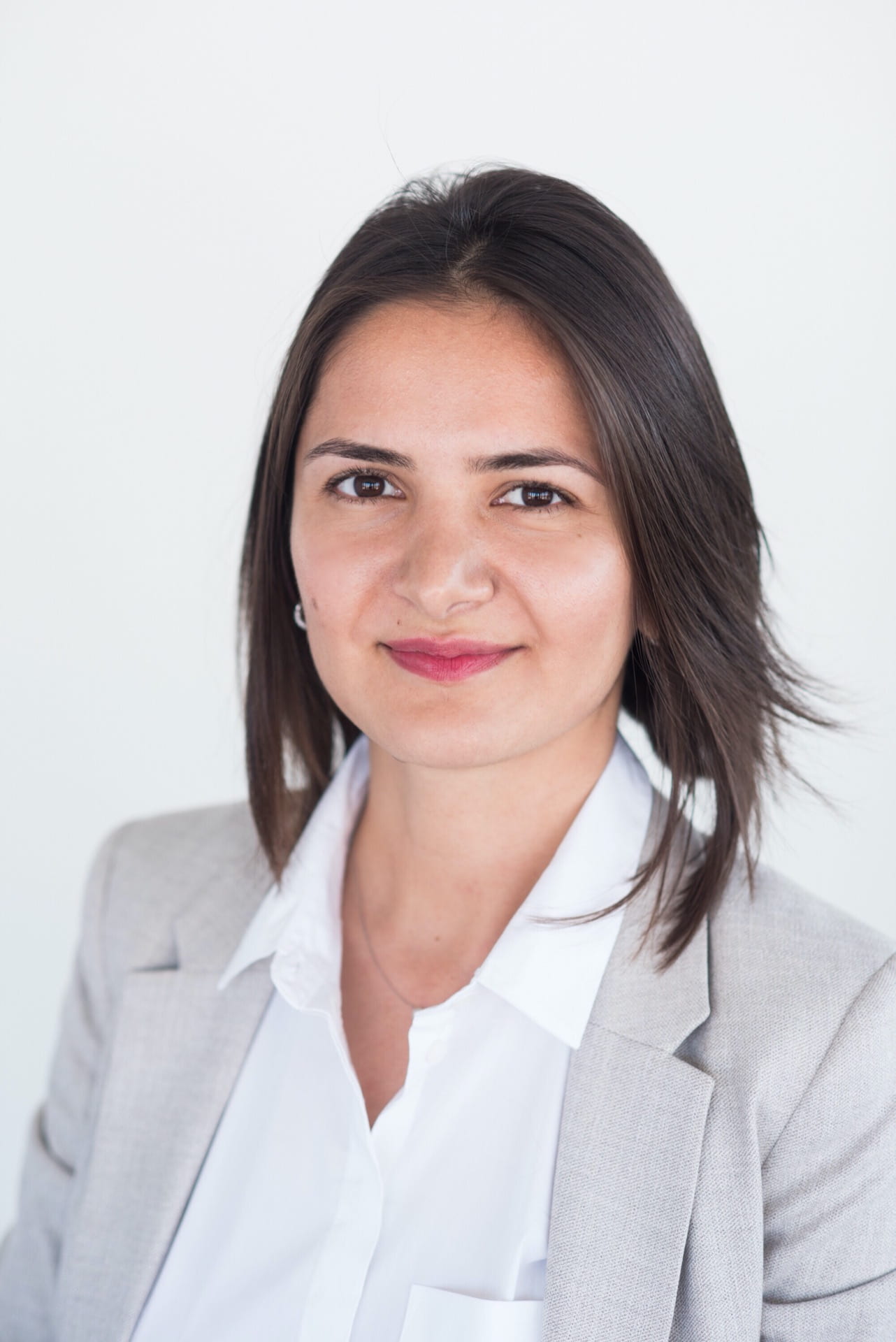
Shams' Headshot

Shams Mammadli
MBA ’21

Shams Mammadli was born on the coast of Baku, Azerbaijan. She grew up there for most of her childhood and later, her education would take her all over the world.

As MBA graduation approaches, Shams is reflecting on her time at McCombs and how her upbringing shaped the worldview she brings to the MBA program.

An International Perspective

Multiculturalism is embedded into the very roots of Azerbaijan. Its culture is a fusion of two factors: the Soviet Union’s 70-year influence on the country and its Eastern European geography. It’s the combination of these two factors that provided Shams with fluency in four languages.

Shams (left) and her mother (right)

Shams Mammadli (left) and her mother (right) during her childhood.

“Imagine growing up in a family where you speak Azeri to your grandma but Russian to your mom; a childhood where your school classes are held in Russian, but you only watch Turkish cartoons; you grow up in a city with mosques, synagogues, and churches.”

The omnipresent immersion of different cultures molded Shams’ perspective of the world to this day. “It becomes a part of you,” she says. “I feel truly fortunate for having experienced such a level of multiculturalism this early and having seen the benefits it poses to society.”

Shams graduated from Azerbaijan State University of Economics with a bachelor’s degree in International Economic Relations in 2014. Aside from Baku, Shams has lived in Moscow, London, and Kansas in pursuit of her education.

“I learned very early on how to feel at home anywhere in the world.”

If There’s a Will, There’s a Way

Regardless of location, there is one common link that has driven Shams all her life: entrepreneurship. 

“It’s what gets me excited: To hear others build something and turn their ideas into reality.”

Shams with a bouquet from her flower entrepreneurial business

Shams Mammadli holding a bouquet of flowers from her entrepreneurial venture, Precious Flowers Houston.

A few years ago, Shams took a leap of faith and started Precious Flowers Houston, an online boutique specializing in floral arrangements packaged in customized boxes. Here, she became familiar with the startup process from start to finish, namely, “designing the website, marketing, networking and building relationships with vendors, communicating with customers, and creating the arrangements.”

This startup allowed her entrepreneurial drive to blossom, but she attributes her biggest lesson learned as something more personal:

“Following your dreams is always worth it, and if there’s a will, there’s a way.”

Currently, Shams is a financial analyst at Leschaco, a transportation and logistics company based out of Germany. Although corporate finance is different from individual entrepreneurship, Shams says her entrepreneurial experience is a “useful foundation” to set her up for future success.

Shams’ Why McCombs 

In 2015, through the Diversity Immigrant Visa program, Shams and her husband moved to the United States. 

“As someone who has been traveling quite frequently and is always ready for a new challenge, I didn’t think twice before leaving everything behind and moving to the other side of the world.”

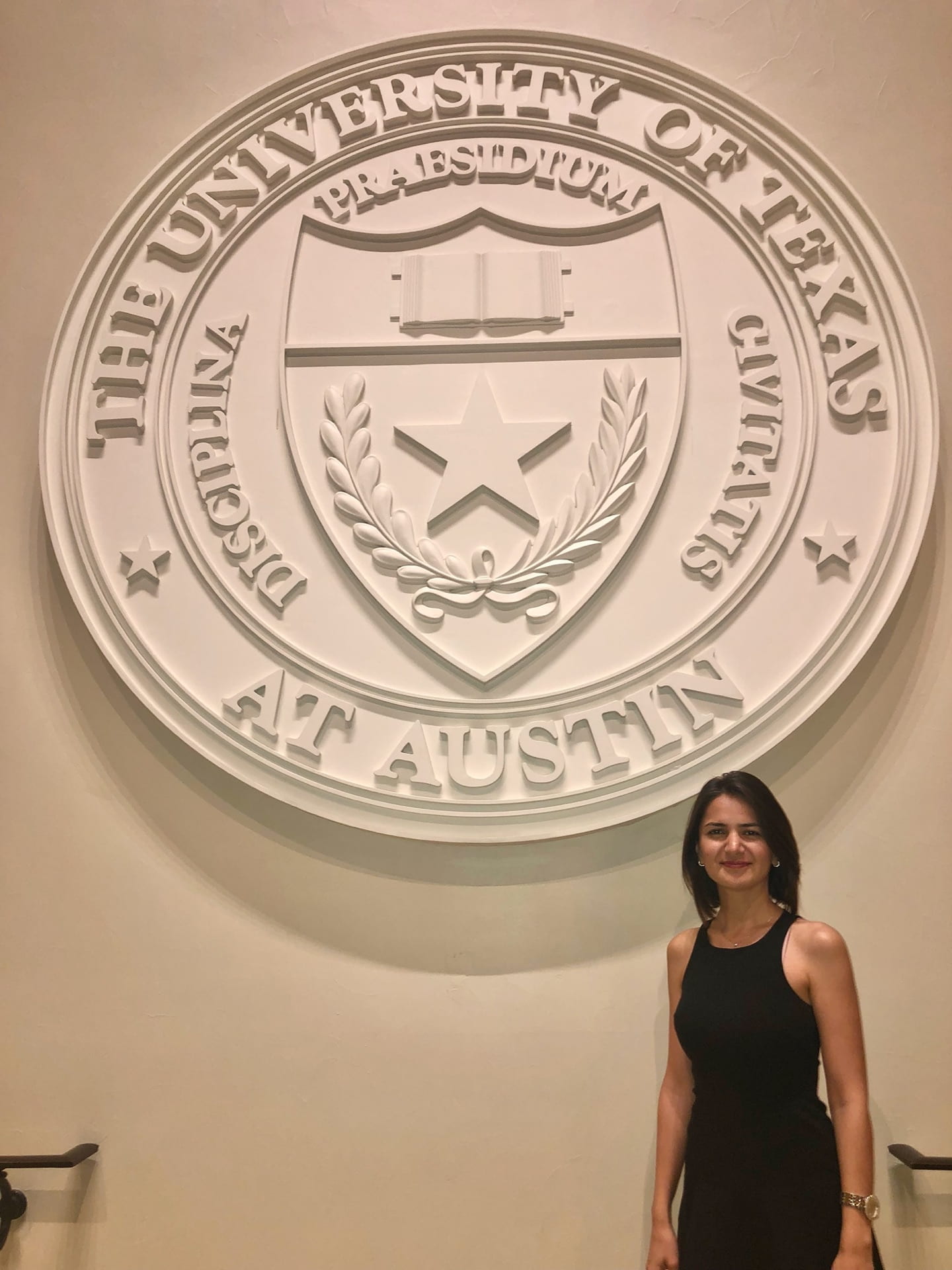
Shams in front of a University of Texas crest mounted on the wall

Shams at The University of Texas at Austin

However, Shams’ #WhyMcCombs moment almost happened back in 2014, when she was still living in Baku, Azerbaijan. She had started an application for her MBA degree at Texas McCombs, but never got around to submitting it because the prospect of it seemed, “so far and unattainable.” Nevertheless, be it a coincidence or destiny, Shams finally submitted and got admitted to the Texas McCombs MBA at Houston program in 2019, after she moved to the city.

Some of the key factors that played a role in Shams’ decision to apply to Texas McCombs were the university’s prestige and the Longhorn network:

“Apart from being a top-ranked program, it’s really the people that make it an amazing place to be — the admissions office, professors, classmates, and the great alumni network that is always willing to help and support.”

Shams attended information sessions held by other universities, but says that she quickly knew McCombs stood out and would be her home. 

“Right from the start, I could tell Texas McCombs is a community of people that genuinely value diversity and are passionate about doing incredible things for the world.”

The Road Ahead

While at McCombs, Shams has worked on multiple projects that have accelerated her knowledge of the type of work she’d like to do after graduation. 

Shams (middle) with her McCombs classmates

Shams (middle) along with her Texas McCombs at Houston classmates.

Shams says that MBA+ projects have allowed her to, “try on different hats,” and decide whether a specific venture would be something she’d want to pursue full-time. This past summer, she completed a mergers & acquisitions MBA+ Project in the healthcare industry, and currently she is working on a  sustainability project for United Airlines — an experience that’s completely new to her. 

“I believe McCombs provides all the resources for those who want to make most out of their experience.”

With graduation just around the corner, Shams is planning to pursue a corporate finance opportunity with a tech company focusing on product development and strategy. However, true to her first true passion, she’s hoping to pursue another entrepreneurial venture sometime down the road.


Visit Texas McCombs MBA to find out more about all our programs, events, and community, or take a peek into student life on Instagram.

Hook ’em!

Older posts Newer posts
Skip to toolbar