Texas McCombs MBA Insider

Insider Information for Prospective Texas McCombs MBA Students

Category: Executive MBA (page 6 of 8)

Scholarships & Financial Aid for Working Professional & Executive MBAs

This information comes from our Working Professional and Executive MBA Admissions team.

At Texas McCombs, we recognize that pursuing an MBA is a big investment in your future. We are proud to have been ranked among the top 10 part-time MBA programs in the U.S. for the past five years.

#7 Part-Time MBA programs, U.S. News and World Report

To make your MBA future attainable as a Working Professional (WP), Texas McCombs awards financial assistance to many students to help cover the cost of education for our Evening, Executive, Dallas/Fort Worth, and Houston programs. In most cases, that aid comes in the form of student loans but there other options that may help fund your MBA. We invite you to review some of these below to help you better navigate this step in your MBA journey.

Continue reading

Which Part-Time MBA Program is Right for You?

This MBA Insider info comes from Sharon Barrett, Director of Working Professional and Executive MBA Admissions.

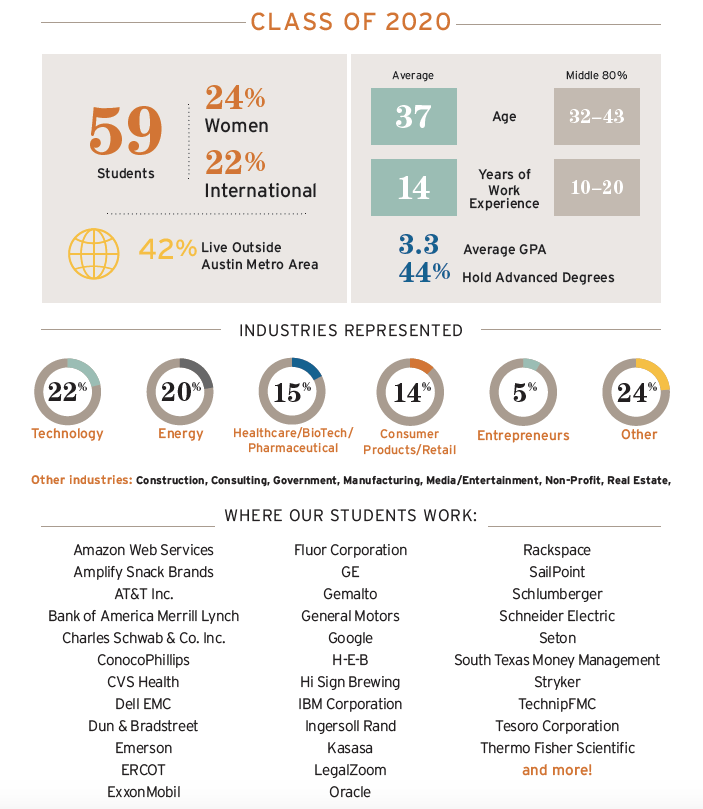
If you compare the class profiles of our Executive MBA with our Professional MBAs– Evening MBA, MBA at Dallas/Fort Worth, and MBA at Houston programs– the differences can seem obvious. But there’s actually a broad grey area, where many professionals could fit well into either the Executive MBA or one of our Professional MBAs.

In the end, it’s a very personal decision about where to submit your application. But remember, it’s a two part process. You decide where you belong and the admissions committee agrees on the fit. Here is some advice on how to make an informed choice about which Working Professional MBA program to choose.

Consider Your Level & Years of Work Experience 

Average work experience for the MBA Programs:

Program 80% Range Minimum
Professional MBA 3-10.5 years 2 years
Executive MBA 9-21 years 8 years

While people with the minimum eight years of experience do join the Executive MBA, there are relatively few. Executive MBA candidates become more competitive closer to ten years of work experience. On the other side, Professional MBA candidates must have a minimum of two years of full-time work experience, and candidates get competitive with closer to four years. The admissions committee doesn’t simply count the years but evaluates the level and quality of your work experience– the impact you’ve made in your organization, advancement in your role or responsibilities, and unique accomplishments.

Continue reading

Crossing all the T’s in your MBA Application

This MBA Insider info comes from the Texas McCombs MBA Admissions Team.

We know you want to put forth the best application you can when you apply to any Texas McCombs MBA program. And we’ve covered many components of the application in the past, including the resume, letter of recommendation, essays, and test scores (as well as some tips for interviewing if you are selected). But some components of the application that might be viewed as procedural are just as important, and if not addressed properly, they can delay processing, which can in turn delay your decision.

When you apply to a Texas McCombs MBA program, you’re actually applying to two separate entities at the same time. One is the McCombs School of Business; the other is the Graduate School of the University of Texas at Austin (which we’ll call GIAC, for the Graduate and International Admissions Center).

Three key components of the application are required by GIAC before it will be considered complete, and GIAC does not allow McCombs to issue a decision until these three elements are completed.

Continue reading

How Test Scores Factor into Your MBA Application

This is the final installment in a series of posts on GMAT/GRE testing. We encourage you to review previous posts, if you have not already. This content was written by Dave Jackson, Senior Admissions Officer, Dallas/Fort Worth MBA.

The Texas MBA Admissions Committee recognizes that you might be putting a lot of pressure on yourself to achieve a high test score.  After all, you’re competitive and driven enough to want to pursue an MBA! It’s important to remember that your test score is only one piece of your story, and it’s considered in the context of your overall application. We review your scores with the knowledge that a test is only one day in your life, and your academic and work history span many years.

Nevertheless, the test is an important component in evaluating your application.

“Quantitative test scores, in particular, have proven to be predictive of success in an MBA program, and taking the GMAT or GRE gets you back into the practice of preparing for exams. The preparation you put into the test sets you up for the mindset you’ll have to bring to your MBA– setting aside time to study on a nightly basis and working your way through problems analytically.”

– Sharon Barrett, Director of Working Professional MBA Admissions at Texas McCombs

Continue reading

Choosing a Test for Your MBA Career Search

This is the third in a series of posts on GMAT/GRE testing. We encourage you to review previous posts, if you have not already. This content was written by Dave Jackson, Senior Admissions Officer, Dallas/Fort Worth MBA.

Before you make a final decision on which test to take, it’s best to research some of your target companies or industries and determine two things:

  1. The extent to which they evaluate a test score in reviewing job candidates.
  2. Whether they have a preference for one of the tests. At McCombs, we have found that most consulting and investment banking firms do look at the candidate’s score, and both industries historically have favored the GMAT.

Regardless of which test you take, you should consider it as another opportunity to not only impress the Admissions Committee, but also potential employers.

Continue reading

The Benefits of MBA Test Prep

This is the second in a series of posts on GMAT/GRE testing. We encourage you to review all posts. This content was written by Dave Jackson, Senior Admissions Officer, Dallas/Fort Worth MBA.

Once you’ve done your research on the format and content of the GMAT and GRE tests, you’re ready to settle on which one you want to take and start your preparation.

If you still need a review of each test to help you navigate the details, see our previous post examining both test options.

Test preparation is critical. The tests are rigorous, but your prep has the advantage of getting you in the right mindset for entering a top MBA program– where the exams and workload will be just as challenging, if not more so.

Prep tools include books that take you through the format of the test and offer practice exams, as well as formal prep classes (in person or online) and tutoring that can cost hundreds of dollars. Going with a more affordable option can work for some candidates.

“If you did well on the SAT or if you have a rigorous math background, you might be able to prepare on your own.”

– Jamie Nelson, an instructor with Manhattan Prep, which offers test prep classes in Dallas, Houston and Austin.

Here are some top prep tips from students and test prep instructors:

Continue reading

Examining Your MBA Application Test Options

This is the first in a four-part series of posts on GMAT/GRE testing. We encourage you to review all posts. This content was written by Dave Jackson, Senior Admissions Officer, Dallas/Fort Worth MBA.

It can be the most stressful part of an MBA application-– the requirement to take either the Graduate Management Admission Test (GMAT) or the Graduate Record Exam (GRE).

At McCombs, the Admissions Committee does not waive this requirement for any of our Working Professional MBA programs (Dallas/Fort Worth, Houston, or the Austin Evening programs) or for our Full-Time program.

So your first question will be: Which test do I take?

Like coffee vs. tea, or vanilla vs. chocolate ice cream, the choice is entirely yours. We have no preference, though more of our students end up choosing the GMAT because it is designed to prepare candidates specifically for business school. And some professions, like consulting and investment banking, do prefer that you have a GMAT score to report. (More on this can be found in our third post of this series.)

While both tests have quantitative and verbal sections, they have noticeable differences. We encourage you to do your research and take practice tests to learn each test’s points of emphasis, and how they are scored.

Here are some key differences between the GMAT and GRE:

Continue reading

The Ins & Outs of the Executive MBA Test Waiver

From Director of Texas Executive MBA Admissions, Sharon Barrett:

Hands down, this is the most common question I get from Executive MBA candidates:

“How does the test waiver work and do I qualify?”

So here’s the lowdown– First and foremost, the Executive MBA is the only Texas MBA program that accepts applicants’ petitions to waive the GMAT or GRE exam requirement. (Key words being “applicant” and “petition.”)  And everyone’s case is different, so there’s no recipe to follow, no checklist, and no guarantee that if you do certain things, you’ll get a waiver.

The MBA Admissions committee views each applicants’ petition in the context of their entire application, and renders a decision on the application versus a separate decision on just the waiver.

Here are the areas of consideration when reviewing an application with a petition for a test waiver:

Continue reading

Applying Late Cycle to the Texas Executive, Dallas/Fort Worth, or Houston MBA Programs

As we’ve stated before, the best time to apply to the Texas MBA Program is when you’re ready and can put forth your best MBA application. If you find yourself ready to apply to our Texas Executive, Dallas/Fort Worth or Houston programs now, in late spring, but think you must wait until the next year’s application cycle, you may be happy to know that these programs currently have a Rolling Deadline and are still accepting applications for the fall 2017 start date. We encourage you to consider this option.

What does “Rolling Deadline” mean?

Continue reading

Applying to the Final Round of the Texas MBA Admissions Cycle

From Texas MBA Working Professional & Executive Program Admissions:

There’s an ice-breaker game often played at events called “Two Truths and a Lie,” where you make three statements about yourself, and others try to guess which statement is false.  We’ll modify that slightly here and call it “Two Truths and a Myth.”

See if you can spot the myth about applying to a Texas MBA Working Professional or Executive (WPE) Program:

  • The Texas MBA is seeking the most qualified candidates for its WPE programs in Dallas/Fort Worth, Houston and Austin.
  • We consider a candidate’s academic performance, work experience and overall motivation in reviewing an application.
  • Candidates must apply early in the process to have a chance at being considered.

Continue reading

Older posts Newer posts
Skip to toolbar