Texas McCombs MBA Insider

Insider Information for Prospective Texas McCombs MBA Students

Category: MBA at Dallas/Fort Worth (page 6 of 7)

Meet Your Working Professional and Executive MBA Career Team

This Insider insight comes from our Working Professional and Executive MBA Career Team.

Texas McCombs MBA Career resources are truly unmatched among other top business schools. Our Career Management team‘s vision is focused on the future, adapting and growing to meet the needs of tomorrow’s career landscape. And they understand that the MBA career path for our Working Professional and Executive (WPE) MBA student differs from full-time students, dedicating a team of career support specifically for our WPE students in Houston, Dallas/Fort Worth, and Austin (Evening & Executive).

The McCombs Difference

MBA program administrators realized they needed to rethink their approach to career management for part-time students.

“We developed an entirely new career management framework that emphasized students’ strengths and interests and better prepared them not only for OCR (on-campus recruiting), but also for other channels that led to experienced hires and will allow them to continually progress in their careers.” – Joe Stephens, Assistant Dean, Working Professional and Executive MBA programs.

The framework, which can be applied in any phase of a student’s career and is tied to students’ career management curriculum and one-on-one advising, includes a market assessment (self-assessment, career exploration, and network creation); value proposition (your brand and competitive advantage, and elevator pitch); sales tools and channels (resume, LinkedIn profile, interview prep, and network cultivation); and launch (plan execution and offer negotiation).

“This career management framework has served as our WPE team’s vision and mission,” says Janet Huang, Director of MBA Career Management at McCombs. (source: Medium)

Meet the WPE Team

Continue reading

Working Professional/Executive MBA Final Round Applicants

This MBA Insider content comes from the Working Professional & Executive MBA Admissions team.

See if you can spot the two true statements and one myth about applying to the Texas McCombs Working Professional or Executive (WPE) MBA programs:

  • The MBA is seeking the most qualified candidates for its WPE programs in Dallas/Fort Worth, Houston and Austin.
  • We consider a candidate’s academic performance, work experience and overall motivation in reviewing an application.
  • Candidates must apply early in the process to have a chance at being considered.

Continue reading

Student Spotlight: Lily Yap, DFW MBA Class of 2020

Lily Yap Headshot

Lily Yap, MBA Class of 2020

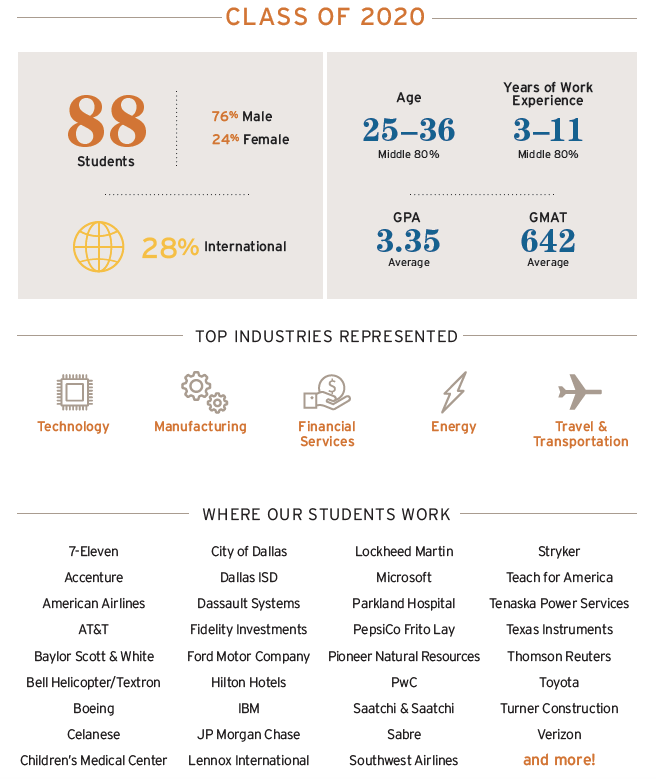
Our Dallas/Fort Worth Class of 2020 welcomed its largest class ever, with 88 new students. This is also the most international class the DFW program has ever had and the most diverse in terms of companies/organizations represented.

We recently caught up with Lily Yap, a DFW MBA student originally from San Francisco, California. She received her Bachelor’s degree from Louisiana State University in Business Management and works on coordinating life-saving programs and operations for animal welfare services in Dallas.

Lily’s “WhyMcCombs?”

Lily was excited to see how passionate the current MBAs in her field are and looked forward to taking leadership classes. She believes classes that refine “soft” skills are extremely beneficial and looks forward to sharing her unique knowledge with other students and organizations.

Continue reading

First Look: MBA at Dallas/Fort Worth Class of 2020

New students from all of our MBA programs recently gathered in Austin to prepare for their classes, get to know each other, meet MBA faculty & staff, and have some fun. It was especially exciting to welcome our classes from Dallas/Fort Worth and Houston to their second home here on the UT Austin campus. These students experience the same top caliber curriculum, faculty, and network as our Working Professional students in Austin, but are able to attend classes close to home on campuses in Dallas and Houston.

We had a very strong pool of applications to pull from when putting together our Working Professional MBA classes this year, and the numbers certainly reflect that. First, let’s take a look at our DFW class:

The MBA at Dallas/Fort Worth welcomed its largest class ever, with 88 new students beginning their MBA journey with Texas McCombs. This is also the most international class the DFW program has ever had and the most diverse in terms of companies/organizations represented.

graphic showing DFW stats for class of 2020: Top Industries include tech, manufacturing, financial services, energy, and travel; top companies include City of Dallas, JP Morgan Chase, Verizon, PepsiCo, Lockheed Martin, Southwest Airlines, and more!

Continue reading

Which Part-Time MBA Program is Right for You?

This MBA Insider info comes from Sharon Barrett, Director of Working Professional and Executive MBA Admissions.

If you compare the class profiles of our Executive MBA with our Professional MBAs– Evening MBA, MBA at Dallas/Fort Worth, and MBA at Houston programs– the differences can seem obvious. But there’s actually a broad grey area, where many professionals could fit well into either the Executive MBA or one of our Professional MBAs.

In the end, it’s a very personal decision about where to submit your application. But remember, it’s a two part process. You decide where you belong and the admissions committee agrees on the fit. Here is some advice on how to make an informed choice about which Working Professional MBA program to choose.

Consider Your Level & Years of Work Experience 

Average work experience for the MBA Programs:

Program 80% Range Minimum
Professional MBA 3-10.5 years 2 years
Executive MBA 9-21 years 8 years

While people with the minimum eight years of experience do join the Executive MBA, there are relatively few. Executive MBA candidates become more competitive closer to ten years of work experience. On the other side, Professional MBA candidates must have a minimum of two years of full-time work experience, and candidates get competitive with closer to four years. The admissions committee doesn’t simply count the years but evaluates the level and quality of your work experience– the impact you’ve made in your organization, advancement in your role or responsibilities, and unique accomplishments.

Continue reading

Crossing all the T’s in your MBA Application

This MBA Insider info comes from the Texas McCombs MBA Admissions Team.

We know you want to put forth the best application you can when you apply to any Texas McCombs MBA program. And we’ve covered many components of the application in the past, including the resume, letter of recommendation, essays, and test scores (as well as some tips for interviewing if you are selected). But some components of the application that might be viewed as procedural are just as important, and if not addressed properly, they can delay processing, which can in turn delay your decision.

When you apply to a Texas McCombs MBA program, you’re actually applying to two separate entities at the same time. One is the McCombs School of Business; the other is the Graduate School of the University of Texas at Austin (which we’ll call GIAC, for the Graduate and International Admissions Center).

Three key components of the application are required by GIAC before it will be considered complete, and GIAC does not allow McCombs to issue a decision until these three elements are completed.

Continue reading

Balancing Act: Family, Work, and Your MBA

This post was written by Dave Jackson, Senior Admissions Officer, Dallas/Fort Worth MBA.

Working professional MBA programs can be challenging when it comes to the competing priorities of work, school, and your personal life. Many wouldn’t think of adding to that mix, perhaps the ultimate challenge: caring for a new baby. Nevertheless, McCombs Working Professional MBA students have shown that a growing family can make it though the program with the right planning, prioritizing, and support network.

“There’s never a ‘right’ time to have a baby,” says Denise Xue, Texas Evening MBA Class of 2017, a financial analyst at Intel who gave birth to her son Daniel in April of 2016, during her fourth semester in the program.

“Having a baby while getting an MBA is certainly not easy, but I never regret one bit. You will be extremely busy, and feel challenged both physically and emotionally, but at the same time you will also feel proud of yourself for the things that you accomplished.”

Here is some advice from Denise and other recent parents for those contemplating parenthood in combination with their Texas MBA:

Continue reading

Choosing a Test for Your MBA Career Search

This is the third in a series of posts on GMAT/GRE testing. We encourage you to review previous posts, if you have not already. This content was written by Dave Jackson, Senior Admissions Officer, Dallas/Fort Worth MBA.

Before you make a final decision on which test to take, it’s best to research some of your target companies or industries and determine two things:

  1. The extent to which they evaluate a test score in reviewing job candidates.
  2. Whether they have a preference for one of the tests. At McCombs, we have found that most consulting and investment banking firms do look at the candidate’s score, and both industries historically have favored the GMAT.

Regardless of which test you take, you should consider it as another opportunity to not only impress the Admissions Committee, but also potential employers.

Continue reading

The Benefits of MBA Test Prep

This is the second in a series of posts on GMAT/GRE testing. We encourage you to review all posts. This content was written by Dave Jackson, Senior Admissions Officer, Dallas/Fort Worth MBA.

Once you’ve done your research on the format and content of the GMAT and GRE tests, you’re ready to settle on which one you want to take and start your preparation.

If you still need a review of each test to help you navigate the details, see our previous post examining both test options.

Test preparation is critical. The tests are rigorous, but your prep has the advantage of getting you in the right mindset for entering a top MBA program– where the exams and workload will be just as challenging, if not more so.

Prep tools include books that take you through the format of the test and offer practice exams, as well as formal prep classes (in person or online) and tutoring that can cost hundreds of dollars. Going with a more affordable option can work for some candidates.

“If you did well on the SAT or if you have a rigorous math background, you might be able to prepare on your own.”

– Jamie Nelson, an instructor with Manhattan Prep, which offers test prep classes in Dallas, Houston and Austin.

Here are some top prep tips from students and test prep instructors:

Continue reading

Examining Your MBA Application Test Options

This is the first in a four-part series of posts on GMAT/GRE testing. We encourage you to review all posts. This content was written by Dave Jackson, Senior Admissions Officer, Dallas/Fort Worth MBA.

It can be the most stressful part of an MBA application-– the requirement to take either the Graduate Management Admission Test (GMAT) or the Graduate Record Exam (GRE).

At McCombs, the Admissions Committee does not waive this requirement for any of our Working Professional MBA programs (Dallas/Fort Worth, Houston, or the Austin Evening programs) or for our Full-Time program.

So your first question will be: Which test do I take?

Like coffee vs. tea, or vanilla vs. chocolate ice cream, the choice is entirely yours. We have no preference, though more of our students end up choosing the GMAT because it is designed to prepare candidates specifically for business school. And some professions, like consulting and investment banking, do prefer that you have a GMAT score to report. (More on this can be found in our third post of this series.)

While both tests have quantitative and verbal sections, they have noticeable differences. We encourage you to do your research and take practice tests to learn each test’s points of emphasis, and how they are scored.

Here are some key differences between the GMAT and GRE:

Continue reading

Older posts Newer posts
Skip to toolbar