Where Are Texas MBAs Studying Abroad?

The map below shows where Texas MBA students studied abroad during the 2012-13 school year.

Overall, 37 MBA students – 30 of them during the 2013 spring semester – participated in exchange programs at 13 different schools in 12 countries. Not all students are pictured on this map.

For more information on each location, click on individual location markers.


View Texas MBA Study Abroad 2012-13 in a larger map

Texas MBAs Take On South Africa

This is a guest post by Blair McGrain, a member of the Texas MBA at Dallas-Fort Worth class of 2013. This past December, Blair took part in a global trip to South Africa as part of the Texas MBA Program. He recounts the experience in the post below.

View of Cape Town

The city of Cape Town, South Africa. Photo by daniel.berlin on Flickr.

South Africa was always on my travel “bucket list” and a place that held a great deal of intrigue to me.  After experiencing what is probably just the tip of the iceberg in terms of things to do and see, I was absolutely blown away by the natural beauty of the country and the warmness of the people.  Plus, I had the added benefit of forming even better relationships with some of my Dallas and Houston program colleagues.

It all started with a well-run and fantastic agenda the school put together for us.  I’m sure it’s not easy herding 40-something students from place to place and keeping them fed and happy…but they did a great job keeping us organized, providing learning opportunities, and keeping a good balance between school and fun/culture.

Johannesburg, which is the epicenter of business and commerce in South Africa, is a bit dangerous and filled with a troubled past that you can almost feel in the air.  But what came across in the people we met is a sense of determination to create a new and better path forward.  Yes, some terrible and atrocious things took place over the past 60 years but most people seem to have embraced forgiveness as the way to a better society.  The township of Soweto (part of Johannesburg) is a tough place to see as a Westerner but I have to say they are the friendliest people I’ve ever come across.

Our trip was partitioned with Johannesburg on the front-end and Cape Town and the Cape Region on the back-end.  It is hard to find a fitting description of how beautiful Cape Town and the region truly is, and I was warned that I’ve probably never seen anything like it.  They were right.  I’ve traveled to many places in the world and I was surprised at the sheer number of must-sees.

The Cape Region wine country was a bit like “Sonoma meets The Rockies” and only an hour’s drive from the city.  It would have been stunning in any weather but we were fortunate to have the most crystal-clear day you’ve ever seen.  Plus, the outdoor luncheon and wine were pretty tasty too.

The Cape Town area also contains one of the world’s leading botanical gardens on the gradual slopes of Table Mountain. Listed as a World Heritage Site and claiming to have to more plant species than any other garden in the world, it was an amazing spectacle for anyone who loves the outdoors.

My travel tales would not be complete without a vivid description of our cage diving experience with the Great Whites off the southern cost of the Cape Region.  Upon my return I told everyone that it was simultaneously one of the most amazing and most miserable experiences I’ve ever had.  Seeing a 15-foot Great White a foot in front of you should be on everyone’s bucket list.  One of the other groups even experienced one biting the submerged metal cage they were in—inches from their faces!  What it made it such a miserable day was the seemingly endless seasickness that came with 18’ swells that day.  I never thought it would end…but I do have a funny visual of our group—14 of 18 total—lined up down the side of the boat throwing up one after another.

Ahhhh….good times.

Texas MBAs Visit China: Days 3-5

This is the second part of a guest post by Onutase Dehenre, a member of the Texas MBA at Dallas-Fort Worth class of 2013, who recently took part in a global trip to China as part of the Texas MBA Program.

Day 3

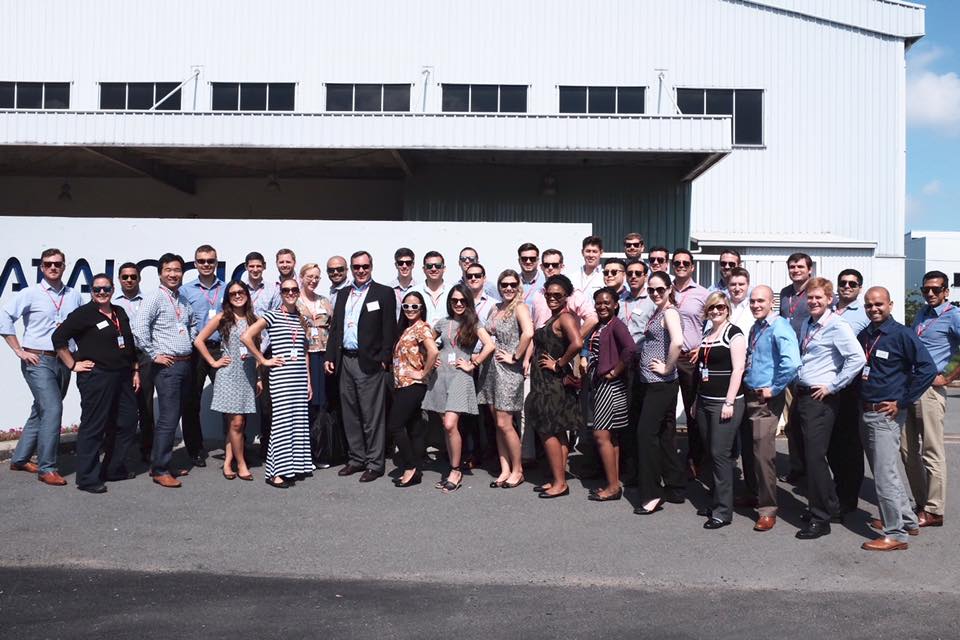
My favorite visit of the trip was first on the agenda: a visit to Anadarko Oil, an upstream independent. While I have an industry bias, what wowed many of us about this company briefing was their rather blunt assessment on capital investments in China.  In short, one must always be aware that the government reigns supreme when you have a joint partnership (or any sort of business in China, for that matter).  They have goals and visions that will likely run contrary to the capitalist concept of maximizing value.  In these cases, our usual models for NPV and terminal growth fall short…an American company may only be running the show and making great profits for a couple of years before control is shifted over to the host-country partners.  Fascinating stuff, as are the very loose contracts that set up the business arrangements.  Interestingly, I started to cross reference the issues we were discussing with our curriculum to date:  Accounting (via their P&L), Finance (via their WACC and country risk applications), Stats/Risk Management (via their oil exploration process), and the ethics portion of this class.  Just to be able to fully understand the topics within a synthesized and real-world environment was just proof that I made the right educational choice.

Here’s another fun fact we learned from the Anadarko oil team:  Drinking games are a form of corporate bonding between teams.  We were told that when there are company dinners, each team (one from the owning company and one from the local company) will submit a roster of folks that are currently planning to attend.  Based off the list, rosters are then re-evaluated and players switched so that each team increases their chance of winning by out-drinking the other.  Craziness, but apparently that goes a VERY long way towards relationship building in the Chinese culture.  Who knew…

Pollution – yes…it exists, in spades in Beijing.  We got some of our best shots of it from Anadarko’s headquarters.  It’s clearly a conundrum…the massive energy output fuels their economy (and some would argue that of consuming nations), but at what cost?  Part of the Global Studies course involved setting up a hypothetical business opportunity in China, and my team chose personal pollution mitigation.  It’s clearly a HUGE opportunity, and I’m glad I only had to spend a couple of days over there.

Ok…on to Marketing!  We got another outstanding presentation on how to market to the Chinese consumer from Madison-Ave darlings Ogilvy and Mather.  Having just completed our Marketing final, the concepts and tactics were thoroughly linked to what we’d just learned.  Very educational stuff on the how the Chinese consumer thinks, and as one would expect, it can be at odds with the Western world.  Here’s another fun fact: the average consumer puts roughly half of their income into savings!  Clearly, advertising to that consumer requires different messaging than what we’re used to.

Day 4

One of our teachers, Dr. Chen, plays the zheng, a traditional Chinese instrument, in one of BOCO’s relaxation rooms.

On Thursday, we got to visit our first private Chinese company: Bright Oceans Inter-Telecom, otherwise known as BOCO.  This is a conglomerate of different businesses, with a technology underpinning.  They’re into software, road-building, telecommunications, and a lot of other things.  We got a tour of their headquarters, as well as a very informative video on what it is their company does, and plans to do.  Ironically, they reminded many of us of Microsoft as we toured their area, with rooms for working, coding, meditating, stargazing, etc.

In the afternoon, we got a visit from the CEO of Coldwell Banker Real Estate, China.  As one can imagine, there’s great demand for real-estate, with all of the growth taking place.  Although some of this demand is local, lots of the real-estate needs are by foreign companies looking to set up shop in the Chinese market place, and having CBRE experts on the ground facilitates that.  This was another key piece of the “how” to enter a Chinese marketplace, and once one combines the foreignness of the need with the complexity, a huge need for Real Estate services can be seen.  Again, another great high-level presentation of on how to take advantage of the exciting growth in China.

Day 5

Was woken up at the unholy hour of 5:30am by the tailor.  I guess I shouldn’t complain.  But it’s early.  Why was a tailor waking me up, you ask?  Well, to get customer-tailored suits made, of course.  OCR is right around the corner, and although I might not have that perfect GPA, I can at least be Dapper Dan, at a very inexpensive price.

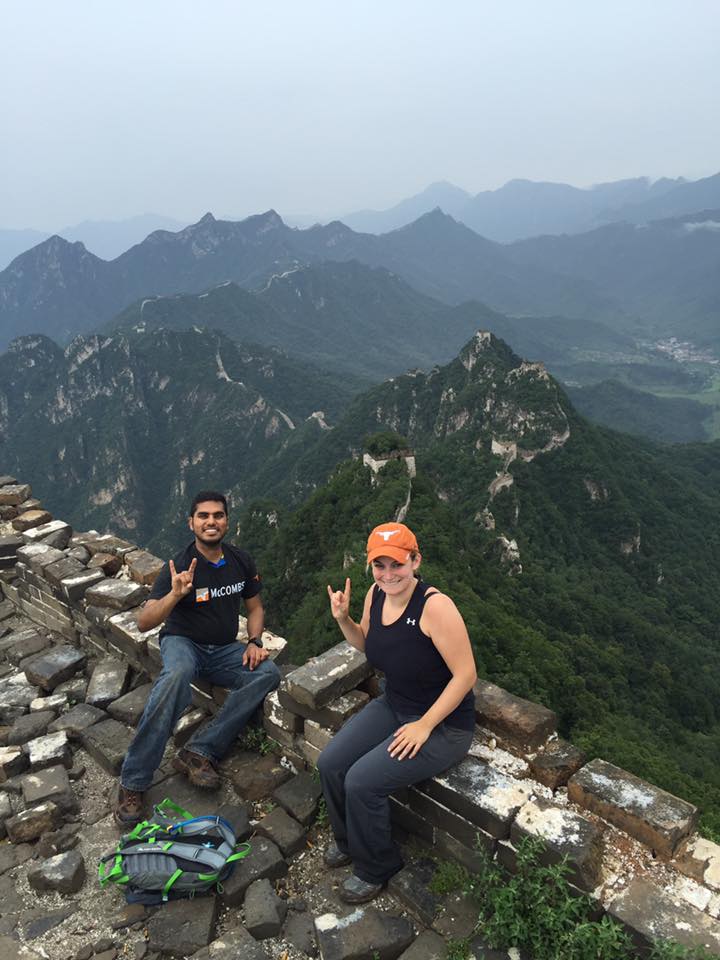
Finally!  Visited the Great Wall.  “Unreal” is about the only world that comes to mind.  You hear all those legends about being able to see it from space and all, but it’s just massive up close.  After trying to imagine the manpower and resources that must have gone into building this thing, the only thing I could think of was that it has to be the mother of all CAPEX projects.  Try setting up that DCF model.  After that, we got lunch at a Jade restaurant, and got to see the Ming Tombs before having one last dinner together, and then preparing for the journeys home.

However, there’s one last tale to be shared, both embarrassing and of a pedagogical nature.  Apparently some of our Houston brethren arrived a little early, and decided to check out the night life.  Some fellow party-goers asked them to go drink with them, and sure enough, a good time was had by all, with drinks flowing freely.  However, the bill came due, and here the story gets fuzzy, but the amount due was either 2500 Yuan, or $2500 dollars, payable in full by our brethren, an unconscionable amount no matter what was due.  The story spread like wildfire, with sheepish grins abound, but the lesson: if someone asks you to go drinking with them, be very mindful, as you’re easy prey.  Culture shock at its finest.

With that, wheels up.  Can’t wait to get back!

OD

Vote In The 2012 Global Connections Photo Contest!

Each year, the Texas MBA program hosts the McCombs Global Connections Photo Contest, a showcase of the exciting travels, experiences, and adventures of MBA students who participated in a two week study tour as part of their Global Connections course during the spring.

With this year’s five spring Global Connections trips now in the past, the contest is underway–and we really need your help in choosing the winners. So, do you think you can help us decide the best photo in this year’s contest?

Vote for your favorite photos in the 2012 MGC Photo Contest!

Don’t wait around, the voting period only runs through Wednesday, April 25th. The photos with the most votes will win cash prizes. Contest details and instructions can be found on the MGC Photo Contest website.
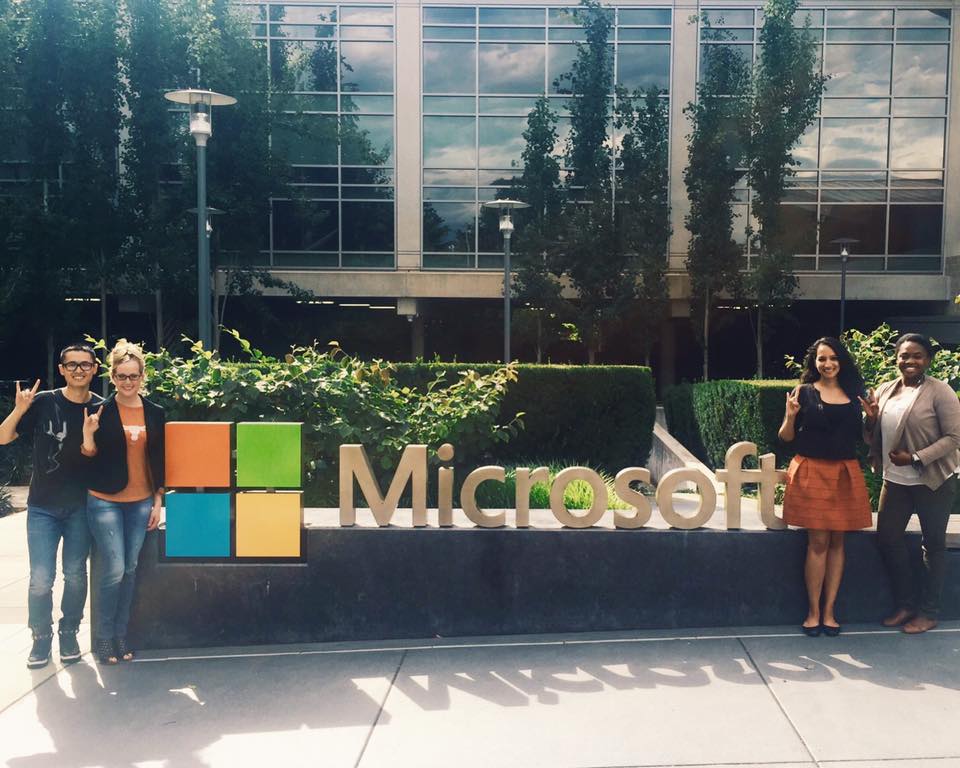
2011 Winner

"Divine Dichotomy" by Chris McClure, 2010 MGC Photo Contest Best in Show

Texas MBA Climbs In Expansión Magazine Global Ranking

Originally posted by Matt Turner on the McCombs Today blog.

McCombs climbed six spots to no. 23 worldwide in Expansión magazine’s annual ranking of MBA programs, billed as the “best global MBAs for Mexicans.” Harvard, Stanford and London Business School top the list, respectively.

McCombs holds steady in rank both among U.S. schools (14), and among American public institutions (3). Only Berkeley (11) and UCLA (21) fare better among public schools.

Other Texas schools in the ranking include: Rice (27), Texas A&M (42), SMU (52) and TCU (63).

Arguably the most important business magazine in Mexico, Expansión has been ranking MBA programs on a global basis since 2006.

For the first time this year, Expansión broadened its international diversity data to reflect the entire suite of MBA programs that many schools offer. For McCombs this includes the full-time MBA, three working professional programs and two executive MBAs.

“Our ties to Latin America have long been one of our strongest international assets,” says Eric Hirst, associate dean of graduate programs. “We have partnerships with some of the most prestigious MBA programs in six Latin American countries.”

Hirst adds that McCombs’ relationship with partner institutions in Mexico is particularly strong. “Our Executive MBA at Mexico City with our partner school, Instituto Tecnológico y de Estudios Superiores de Monterrey (ITESM-EGADE), has really strengthened our brand among Mexican nationals.”

Mexico, Hirst notes, is second only to India as the most-represented foreign country among incoming students in the six programs offering the MBA degree.
In Hirst’s view, Mexico’s growing economic and cultural ties to Texas, “is strategically important to the school and offers us a competitive advantage” in attracting good students.

Expansión methodology includes: salary and employment issues (25 percent); GMAT average (20 percent); percentage of faculty with doctorate degrees (20 percent); international diversity issues, with Latin American emphasis (10 percent); and faculty research (5 percent). The remaining 20 percent comes from a survey of Expansión readers and of academics and alumni of Mexican MBA programs.